|
Guitar Chords
and
Diatonic Chord Construction
(all instruments)
Chord -
3 or more notes played at the same time.
|
|
|
|
Join Mailing List for site updates, contests
and practice tips!
click here |
 |
|
|
|
|
|
|
|
|
|
|
|
|
|
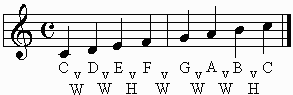
Chords are built from scales so we will start by building a
major scale. For now we will use the C major scale.
Review
Scales if needed.
|
|
 |
|
|
Diatonic Chords - chords belonging
to one key.
Stack the notes (line, line, line, space,
space, space, etc) from each scale degree (note) from the C
major scale and we end up with the 7 diatonic triads (chords)
belonging to the key of C major.
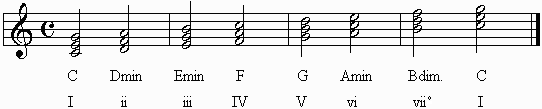
We end up with a series of major and minor chords with the seventh
one called diminished. These are the chords belonging to the key
of C.
Because all major scales are built
the same way:
WWHWWWH
the I IV and V are the
major chords in every major key.
ii, iii and vi are the minor
chords in every major key.
vii is called diminished
in every major key.
|
|
|
|
|
|
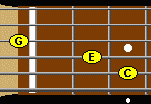
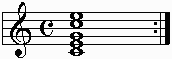
C Major Chord
Stack the notes
line line line from C and we end up with the 1st (C),
3rd (E) and 5th (G) degrees of the C major scale. If we
translate this to the fretboard we have this:
|
|
|
|
|
|
|
|
|
|
|
|
|
|
|
|
|
|
|
|
|
|
|
|
|
|
|
|
|
|
|
|
|
|
|
|
|
|
|
|
|
|
|
|
|
|
|
|
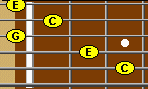
It is not easy
to strum just 3 strings so by adding another 1st and 3rd degree
(both an octave higher) we can now strum strings 5 - 1. Much easier. |
|
|
|
|
|
|
|
|
|
|
|
|
|
|
|
|
|
|
|
|
|
|
|
|
|
|
|
|
|
|
|
|
|
|
|
|
|
|
|
|
|
|
|
|
|
|
|
|
|
|
|
|
|
|
|
|
|
|
|
|
|
|
|
|
|
|
|
|
|
|
|
|
| The
low E is not usually played because it tends to sound muddy.
Block the string by gently touching with your 3rd finger
or bring your thumb up over and touch lightly enough to
stop the string from ringing. |
|
|
|
|
|
|
|
|
|
|
|
|
|
|
|
|
|
|
|
|
|
|
|
|
|
|
|
|
|
|
|
|
|
|
|
|
|
|
|
|
|
|
|
A Minor Chord
Build a chord
from the 6th degree of the C major scale you will find
the notes A , C and E. Because the distance between A
and C is a minor 3rd (3 half steps) the chord will be
called A minor. The difference between major and minor
chords will be explained a little further down the page.
|
|
|
|
|
|
|
|
|
|
|
|
|
|
|
|
|
|
|
|
|
|
|
|
|
|
|
|
|
|
|
|
|
|
|
|
|
|
|
|
|
|
|
|
|
|
|
| Once
again we may want to strum more than just 3 strings. We
can add our low A string and another E (second fret of your
D string). |
|
|
|
|
|
|
|
|
|
|
|
|
|
|
|
|
|
|
|
|
|
|
|
|
|
|
|
|
|
|
|
|
|
|
|
|
|
|
|
|
|
|
|
|
|
|
|
|
|
|
|
|
|
|
|
|
|
|
|
|
|
|
|
|
|
|
|
|
|
|
|
|
Progression
- chord to chord. The
order in which chords are played in a tune.
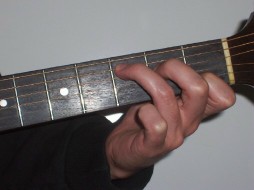
Let's work on changing between the C chord and the A minor.
Only your 3rd finger will move. Your 1st and 2nd finger
will stay in the same place for both chords.
The strum pattern
below will have us play down strokes for 3 quarter notes
on a C chord and then you will have one quarter note rest
to make your switch to the Am chord. Remember to only
move your 3rd finger.

|
|
|
|
|
|
|
|
|
|
|
|
|
|
|
|
|
|
|
|
|
|
|
|
|
|
|
|
|
|
|
|
|
|
|
|
|
|
|
|
|
|
|
Below we will look at two different ways to learn the difference
between major and minor triads.
An
interval is the distance between two notes.
Major
vs Minor (Part 1)
A chord is major or minor depending on the distance
between the first (root) and the third degree.In all of the
chords above, the root is the bottom note and the third is the
middle note. The top note is the fifth but has nothing to do
with a chord being major or minor.
|
|
|
|
|
|
|
|
|
|
|
|
|
|
|
|
|
|
|
|
|
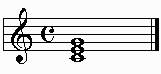
The
first chord built in the key of C is a C major chord and contains
the notes C, E and G. The distance between the C and E would be
two whole steps. The distance between these two notes is called
a major third, making the chord major. |
|
C Major |
|
|
|
|
|
 |
|
|
|
|
|
|
|
|
|
|
|
|
|
|
|
|
|
|
|
|
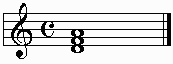
The
chord built from the second degree is D minor and contains the
notes D, F and A. This chord is minor because of the distance
between the root (D) and the third (F). In this case the distance
is one and a half steps or 3 half steps. This interval is called
a minor third and therefore makes the chord minor. |
|
D Minor |
|
|
|
|
|
 |
|
|
|
|
|
|
|
|
|
|
|
|
|
|
|
|
|
|
|
|

Major
vs Minor (Part 2)
Another way to think of major vs minor: The 1st, 3rd and 5th
degree taken from a major scale equals a major chord (1
3 5) . Lower the 3rd degree one half step and you have
a minor chord (1 b3 5) .
|
|
|
|
|
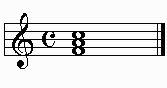
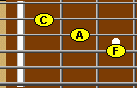
Stack
space space from the fourth degree (F) of the C major scale and
we have the IV chord (F).
The distance between the root (F) and the third (A) is a major
third (2 whole steps or 4 half steps).
This major 3rd makes the chord major.
M3 = 4 half steps
|
|
F Major |
|
|
|
|
|
 |
|
|
|
|
|
 |
|
|
|
|
|
|
|
|
|
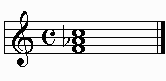
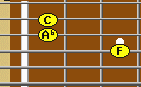
To
make it minor we must lower the third one half step.
By lowering the A to Ab we now have 3 half steps between the root
(F) and 3rd (Ab)
This -3rd makes the chord minor.
-3 = 3 half stepsps
|
|
F Minor |
|
|
|
|
|
 |
|
|
|
|
 |
|
|
|
|
|
|
|
|
|
|
|
|
|
|
|
|
|
|
|
|
|
|
|
|
|
|
|
|
|
|
|
|
|
Note that the
F minor triad could not belong to the key of C because the C scale
didn't contain any sharps (#) or flats (b).
|
|
|
|
|
|
|
|
|
|
|
|
|
|
|
|
|
|
|
|
|
|
Thank you for taking the time to
check out my page on basic chord construction! I hope
you found it to be helpful.
My name is Teague Purtell and I
have been playing and teaching music for over 20 years.
This site is an extension of me and my love of playing
and sharing music.
Become
a Member!
The members section is
a complete online guitar method I have been developing
since I first put this site online in 1999. My main purpose
is to make learning the guitar easy and fun for you!
I hope you allow me to
be part of your guitar learning journey :)
|
|
|
|
|
|