|
|
|
|
|
|
|
|
|
|
|
|
|
|
Rhythm Reading
|
|
|
|
|
|
|
|
|
|
|
|
|
|
|
|
|
|
|
|
You should take the time every
practice session to work on specific rhythms. Let's first
learn a bit about rhythm and at the bottom of the page
you can choose from a variety of cool rhythm exercises:
The time signature is placed after
the treble clef.
|
|
|
|
 |
|
Any key other
than the key of C major/ A minor would have sharps (#) or
flats (b) placed between the Treble clef and Time Signature.
|
|
|
|
|
|
|
The top number tells us
how many beats we can have in each measure.
The bottom number tells us what type of note gets
the beat. (This is also how long the whole
note will be held for)
The 2 measures below are divided
by a bar line.
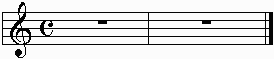
The double bar line at the end represents the end.
Common time (C) is the same as 4/4

|
|
|
|
|
|
|
|
|
|
|
|
|
All the examples on the right have a
metronome set at 60bpm (beats per minute) and all are common
time (4/4).
60bpm is the tempo.
The quarter note gets the beat in common
time (4/4) and with the metronome set at 60 it would be the
same as the second hand on a clock.
Please note: The time signature does not have anything to do
with the tempo (speed) of the song. The time signature tells
us what of type of note gets the beat and how many beats are
in each measure.
|
|
Feb. 15, 2017
Sorry I accidentally messed up this player today. I will fix
it tomorrow. For now you can become a member for free by subscribing
to my mailing list. See bottom of page.
Teague
|
|
|
|
|
|
Whole note
Worth 4 beats in 4/4 orth
4 beats in 4/4

|
The whole note is held
for the value of the bottom number in the time signature. In
4/4 or Common time the bottom number is 4 and so the whole note
is held for 4 beats. Because the top number is also 4 we can
only have 4 beats in a measure. Since the whole note is worth
4, we can't fit anything else in this measure.
Listen
midi file for slower connections (right click to open in new
window)
|
|
|
|
|
|
|
|
|
|
|
|
|
|
|
|
|
|
|
Half note
Worth 2 beats in 4/4

|
The half note is worth
half of the whole note.
So if the whole note is worth 4 beats, the half note is worth
2. As long as the top number is 4, we can have 4 beats which
means we can put 2 half notes in the measure.
Listen
|
|
|
|
|
|
|
|
|
|
|
|
|
|
|
|
|
|
|
Quarter note
Worth 1 beat in 4/4

|
The quarter note will be
worth half of a half note. So in the case of 4/4 where the half
note was worth 2, the quarter note will be worth 1 and we could
have 4 in a measure.
Listen
|
|
|
|
|
|
|
|
|
|
|
|
|
|
|
|
|
|
|
Eighth note
Worth 1/2 a beat in 4/4

|
The eighth note
is worth half of the quarter note. Which means it is only worth
half of a beat. 2 connected together would be worth 1 beat and
we could put a total of 8 in a measure.
Listen
|
|
|
|
|
|
Sixteenth note
Worth 1/4 of a beat in 4/4

|
The sixteenth note will
be worth half of an eighth note. So a single sixteenth note
in 4/4 time would only be worth 1/4 of a beat. You could play
4 sixteenth notes in one beat and 16 in a measure.
Listen
|
|
|
|
|
|
|
|
|
|
|
|
|
|
|
|
|
|
|
|
|
|
|
|
|
|
|
|
|
|
|
|
The exercise to the left uses just
your open G string.
Listen

|
|
|
|
|
|
|
|
|
|
|
|
|
|
|
|
|
|
|
|
Below you can compare 4/4 with 6/8 time. Notice with each new
note value it is half of the previous note value. |
|
|
|
|
|
|
|
|
|
|
|
|
|
|
|
|
|
|
|
|
4/4
- Whole = 4
- Half = 2
- Quarter = 1
- Eighth = 1/2
- Sixteenth = 1/4
|
|
6/8
- Whole = 8
- Half = 4
- Quarter = 2
- Eighth = 1
- Sixteenth = 1/2
|
|
|
|
|
|
|
|
|
|
|
|
|
|
|
|
|
|
|
|
|
|
|
|
|
Thank you for taking the time to
check out my page on basic chord construction! I hope
you found it to be helpful.
My name is Teague Purtell and I
have been playing and teaching music for over 20 years.
This site is an extension of me and my love of sharing
music.
Become
a Member Today!
The members section is
a complete online guitar method I have been developing
since I first put this site online in 1999. My main purpose
is to make learning the guitar easy and fun for you!
I hope you allow me to
be part of your guitar learning journey :)
|
|
|
|
|
|
|
|
|
|
|
|
|
|
|
|
|
|