Major vs Minor Chords
Two Ways to Look at the Difference Between Major and Minor Chords
Part 1
In Chord Lesson 3 we learned chords are built from scales and of the 7 chords that all belonged to the key of C, three were major, three were minor and one was called diminished.
C Major Scale
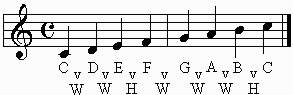
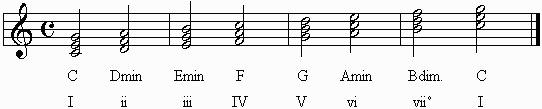
A chord is major or minor depending on the distance between the root and 3rd degree of the chord. In all the chords from lesson 1 of this series the root was the bottom note and the 3rd was the middle. The top note was the 5th but will not play a factor in a chord being major or minor. However if you remember from last lesson the 5th does play a part in diminished chords.
The first chord built in the key of C is a C major chord and contains the notes C, E and G. The distance between the C and E would be two whole steps. The distance between these two notes is called a major third, making the chord major.
C
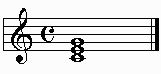
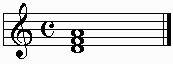
The chord built from the second degree is D minor and contains the notes D, F and A. This chord is minor because of the distance between the root (D) and the third (F). In this case the distance is one and a half steps or 3 half steps. This interval is called a minor third and therefore makes the chord minor.
Dm
Part 2
Another way to think of major vs minor: The 1st, 3rd and 5th degree taken from a major scale equals a major chord (1 3 5) . Lower the 3rd degree one half step and you have a minor chord (1 b3 5) .
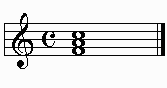
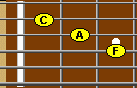
Stack space space from the fourth degree (F) of the C major scale and we have the IV chord (F).
The distance between the root (F) and the third (A) is a major third (2 whole steps or 4 half steps).
This major 3rd makes the chord major.
Major 3rd (M3) = 4 half steps
F major
To make it minor we must lower the third one half step.
By lowering the A to Ab we now have 3 half steps between the root (F) and 3rd (Ab)
This -3rd makes the chord minor.
Minor 3rd (-3) = 3 half steps
F minor
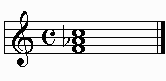
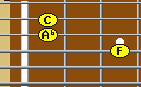
Note that the F minor triad could not belong to the key of C because the C scale didn't contain any sharps (#) or flats (b).
G
Root
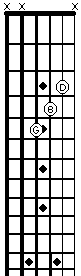
G
1st Inversion
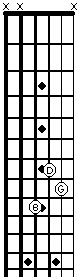
G
2nd Inversion
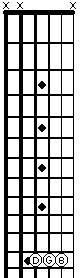
G Minor
Root
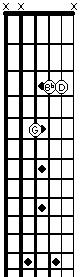
G Minor
1st Inversion
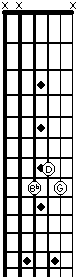
G Minor
2nd Inversion