
Chord Lesson 2
C to Am
Lesson 2 - C to Am
Part 1
In Part 1 we learned that chords are built from scales and we learned 7 chords that all belonged to the key of C. We learned that some of those chords were major and some were minor and one was called diminished.
A chord is major or minor depending on the distance between the root and 3rd degree of the chord. In all the chords from lesson 1 of this series the root was the bottom note and the 3rd was the middle. The top note was the 5th but will not play a factor in a chord being major or minor. However if you remember from last lesson the 5th does play a part in diminished chords.
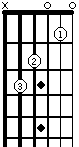
C Chord
You could also call it C major
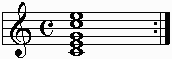
When we stack the notes line line line from C we end up with the 3 notes in a C chord (or triad). The C is called the 1st degree or more often the root of the chord, the E is called the 3rd and the G is called the 5th. Note they were the 1st, 3rd and 5th degree of the scale.
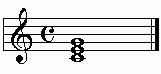
There would be two different places we could play these notes together on the guitar but for now we will look at 1st position.
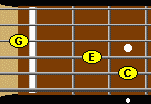
Because it is a bit tricky to play only these 3 notes we can make it bigger by adding more notes so long as they belong to the C chord. So C, E or G. Below we have added another C and another E (our high open E string). We would no longer call this a triad and now refer to is as a chord.
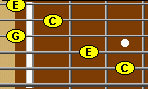

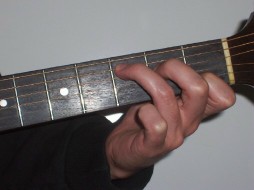
Even though E is a part of the C chord and we have a low E string, it is quite often not played as it tends to have a muddy sound. You can try to avoid hitting the 6th string with your pick or you can bring your thumb over the top of the fretboard and press ever so gently to stop the string from ringing. It is also possible to have your 3rd finger that is playing the C to touch it gently.
Am Chord
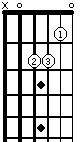
Also called A minor and sometimes written as Amin
Build a chord from the 6th degree of the C major scale you will find the notes A , C and E. Because the distance between A and C is a minor 3rd (3 half steps) the chord will be called A minor. The difference between major and minor chords will be explained a little further down the page.


Once again we may want to strum more than just 3 strings. We can add our low A string and another E (second fret of your D string).


Let's Play some Guitar 🙂
For beginners let us work on sounding a C chord and then switching to Am chord.
Progression - chord to chord. The order in which chords are played in a tune.
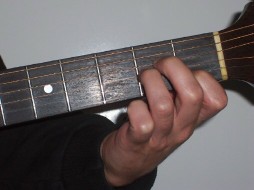
Let's work on changing between the C chord and the A minor. Only your 3rd finger will move. Your 1st and 2nd finger will stay in the same place for both chords.
The strum pattern below will have us play down strokes for 3 quarter notes on a C chord and then you will have one quarter note rest to make your switch to the Am chord. Remember to only move your 3rd finger.
