
D Major Scale and its relative B Minor Scale
A Look at the Different D Major/B Minor Scales Used Throughout Site
A great way to see the whole step and half step relationship between notes is to build the scale on one string.
In Scale Lesson 2 we learned all major scales are built with one formula:
W W H W W W H
Start on D and follow the formula:
D E F# G A B C# D
We learn that a D major scale has 2 sharps (F# and C#). This also means that the Key of D Major and its relative B Minor have the same two sharps (F# and C#).
More on the Minor scale below.
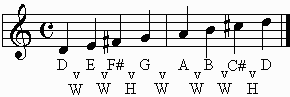
D Major on the D string
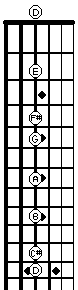
Review of Pentatonic
We can create a pentatonic scale by taking the 4th and 7th notes out of the D major scale.
D Major Scale:
D E F# G A B C# D
D Major Pentatonic:
D E F# A B D
The same two notes are removed for a B minor pentatonic scale. You could think of it as the 2nd and 6th removed. I usually just think about it as the 4th and 7th from the major scale and then know that it is the same two notes missing for the relative minor pentatonic.
B Minor Scale:
B C# D E F# G A B
B Minor Pentatonic:
B D E F# A B
2nd Position
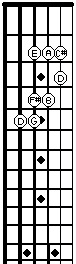

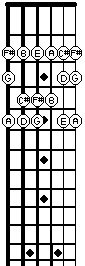
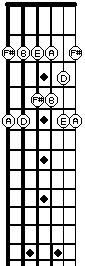
4th Position
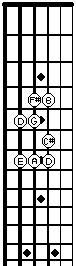
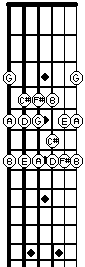
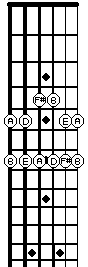
7th Position

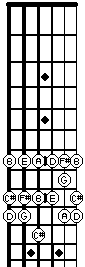
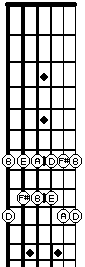
9th Position
To the right is a 2 octave D major scale in 9th position. The staff starts on a D even though the fretboard shows a C#. The 2nd last note of the scale on the staff uses the C#.
Also note the fretboard shows a high E which is not on the staff. So basically the fretboard is showing the scale in what I like to call extended positions. Meaning it is showing all of the notes from the scale in that position.


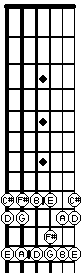
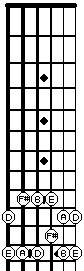
B Minor
Every major key has a relative minor. To find the relative minor of your favorite major key go down a minor third (3 half steps) from the root.
So if you look at the D on the 12th fret of your 4th string (D String) and go down 3 half steps you will end up on B. B minor is the relative minor to the key of D major. D major and B minor are related. These two keys share the same notes, same key signature and same chords.

D Major Pentatonic
A major pentatonic scale is a major scale missing the 4th and 7th degree (note). So in the case of D major pentatonic we have to take out the G and the C# from the D major scale.
This is also know as a B minor pentatonic if played from B to B.

