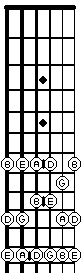
G Major/E Minor
A look at a few forms of G major and E minor scales
G Major/E Minor in open (Also known as 1st position)
You will recognize this shape from lesson 5. This also happens to be the 5th position C major shape that is in Lesson 8.
Play from G to G and you have a G major scale.
Play from E to E and you have an E minor scale.
E minor is the relative minor of G major. In other words, they share the same key signature (1 sharp - F#) and the same notes and the same chords.
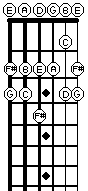
The audio player is playing a 1 octave G major scale in open position starting on the G string and going up one octave to the 3rd fret of the high E string. Quarter notes (one note per beat in 4/4)
G Major Pentatonic
G Major Pentatonic
We remove the 4th and 7th degree of a major scale to get the major pentatonic scale.
G major is: G A B C D E F# G
The 4th degree is C and the 7th degree is F#. Remove these two notes and we have a G major pentatonic scale.
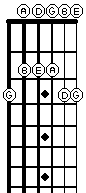
E Minor Pentatonic
E Minor Pentatonic
Play the same 5 notes but from E to E and you have an E minor pentatonic scale.
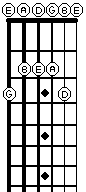
G Major / E Minor Pentatonic
G Major/E Minor Pentatonic
We remove the 4th and 7th degree of a major scale to get the major pentatonic scale.
G major is: G A B C D E F# G
The 4th degree is C and the 7th degree is F#. Remove these two notes and we have a G major pentatonic scale.
Play the same 5 notes but from E to E and you have an E minor pentatonic scale.
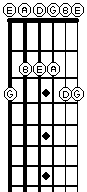
G Major / E Minor in 2nd Position
G Major/E Minor in 2nd Position
This scale form is first learned in the key of C and found in Lesson 14. It shows up again in Lesson 15 in the key of G.
By Lesson 15 you should also have the 2 string G major arpeggio that moves from 2nd to 4th and then 7th position.
Lesson 15 also introduces a G major 7th arpeggio in 2nd position.
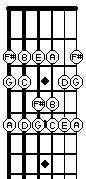
G Major / E Minor Pentatonic in 2nd Position
G Major/E Minor Pentatonic 2nd Position
Same as above but in 2nd position. Remove the 4th and 7th degree of the G major scale and you have a G major pentatonic scale.
Play from E to E and you are playing an E minor pentatonic scale.
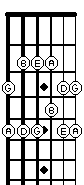
Both Positions Together
G Major/E Minor Covering Both Positions
Here is a look at the two positions on one fretboard diagram. As we get more comfortable with both positions and comfortable with shifting, we will move back and forth through these positions when soloing.
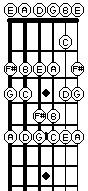
7th Position
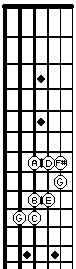
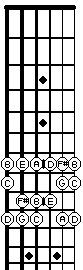
G major scale in 7th one octave. Note it is the same shape as your C major scale in open (also known as 1st position) that we learned in Lesson 2.
The other fretboard shows the scale extended in the position. This will make it easier to see the E minor scale as well.
Play from E to E and you are playing G majors relative minor, E minor.

9th Position
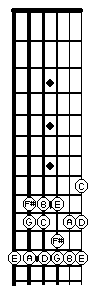
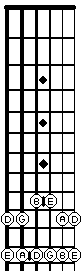
E minor in 9th position
G Major / E Minor Pentatonic in 7th and 9th Position