
Main Lesson 1
For the Complete Beginner
Whether you are a complete beginner or have played for years, plan to spend at least 5 minutes on each section of this lesson. Some may only need to do it once and move on to lesson 2, while others may want to spend 10-15 minutes a day for a week before continuing with lesson 2.
The 7 topics to the right will be in each lesson. They are not only lesson topics but the 7 areas of what will become your daily practice routine.
The navigation menu to the right should reflect that when I have it cleaned up.
- Theory
- Scales
- Chords
- Arpeggios
- Rhythm/Strumming
- Improvising/Jam Tracks
- Songs
Every Lesson
- Basics/Theory - Theory, Ear Training, Reading, Writing
- Technique - Scales, Arpeggios, Finger Exercises
- Chords - New Chord Every Lesson While Reinforcing Past Chords
- Rhythm/Strumming - Each New Strum Patterns Expands on the Last
- Improvising - Jam Tracks with Different Tempos, Feels and Keys
- Riffs/Songs - Musical Examples Chosen to Work with Lesson Material. Some lessons include singing and playing.
- Fingerpicking - Each New Fingerpick Pattern Expands on the Last
This Lesson
- Basics/Theory - The 12 Tones and our open strings
- Technique - Finger Gymnastics
- Chords - Em to Asus2 (sounds complicated but it isn't)
- Rhythm/Strumming - Easy Pattern with Quarter Notes
- Improvising - Intro to using jam tracks to practice
- Riffs/Songs - Intro to Nothing Else Matters
- Fingerpicking - Get Started with Using your Fingers
Theory: The 12 Tones
Each Lesson Will Expand Our Theory Knowledge
Basic Theory
I do not want to get to deep into music theory on the first lesson as I know you would probably like to play something.
However I do want you to get a basic understanding of the 12 tone system. There are 12 tones used in tonal music that make up everything from Beethoven's 5th symphony to Duke Ellington's Take the A Train and Metallica's Master of Puppets to John Coltrane's Giant Steps.
7 are named the first 7 letters of the alphabet: A B C D E F G
The white keys on the piano are these 7 letters repeating over and over.
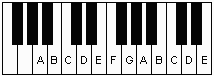
The piano is such a great visual instrument we will use it occasionally when talking about music theory.
The remaining 5 notes are the black keys and can be called a sharp (#) or a flat (b).
Ex. The black key in between C and D on the piano has 2 names. Sometimes we will call it C sharp (C#) and sometimes D flat (Db) depending on the context.
The sharp sign (#)
raises a note a
half step.
A#=Bb
C#=Db
D#=Eb
F#=Gb
G#=Ab
The flat sign (b)
lowers a note a
half step.
Scales
A Quick Look at How the Fretboard Works and What a Scale is
What is a Scale?
A scale is a series of notes in a specific order. There are many types of scales and throughout the series we will look at major, minor, pentatonic, harmonic minor, melodic minor and modes.
This first scale has a fancy name and we are not concerned with remembering this name at this point. We simply are looking at how the alphabet letters are used on the fretboard.
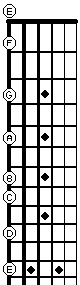

Technique: Finger Gymnastics
Most Technique Lessons Will Involve Scales and Arpeggios
Finger Gymnastics
This is an exercise you start today but will hopefully play variations of forever. I still do and I have been playing for 30 years 🙂
- Video
- Drum Beats to play along with
- Pictures of Positions
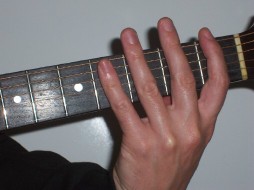
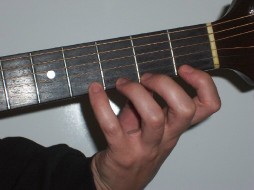
Chords: In This Lesson We Look at Two Easy Chords
By the End of This Course You Will Be Able to Play Any Chord
Easy Chords
I have taught a long time and have tried different ways of approaching learning chords with students. This is what I think to be the easiest and the best. Plus it is going to have us playing songs in no time.
- Em to Asus2
- Video
- Jam Track to Play Along with (Actually this will probably go below in Strumming)
Arpeggios
Learn what an Arpeggio is and how to play and Easy one
Arpeggio
An arpeggio is a broken chord. In other words instead of strumming a chord you play each note of the chord one at a time. Throughout the lessons we will learn many different types of arpeggios and different ways to play them like:
- Finger picking
- Sweep picking
- Tapping
Arpeggios are also an important part for:
- Learning the fretboard
- Understanding music theory and specifically what notes belong to what chords
- Ear Training
- Tecnique
Rhythm/Strumming
Each Lesson We Will Devote Some Time to Becoming Better Rhythm Players
Basic Rhythms
For our first rhythm lesson we will look at some basic notes and the value assigned to each:
- Whole
- Half
- Quarter
- Eighth (Maybe, this might be saved for Lesson 2)
Improvising/Soloing
Jam Tracks to Practice Using What You Have Learned Each Lesson
Improvising
For this first improvising lesson we will use the finger gymnastics from above and try practicing along with some drum tracks.
You should try using the notes you have learned so far:
- Whole
- Half
- Quarter
- Eighth
2 or 3 mp3 players with drum tracks will go here. Different tempos and feels.
Songs and Riffs
Each Lesson Will Take the Material from Above and Apply it to Learning a Song or Riff
Metallica - Nothing Else Matters Intro
This lesson just has the one riff to accompany the material. This particular intro uses an arpeggio and we can fingerpick it or play it with a pick. I would suggest trying both.
Links to all songs that will apply to the above material.
Some Lessons will have many links in which case you can learn them all obviously or just pick the ones that appeal to you. They will all have you working on the material from above. Others may only have one in which case I feel it is important to connect the material.
Homework
Things You Should Be Working on Daily (If possible)
Let's Get Excited!
So with our homework section, I will have practice tips to making your practice time more effective. Plus I will list the highlights from the lesson for working on even if you don't want to log on.
Lesson 1
- Finger Gymnastics - Probably most important
- Rhythm